Views: 0 Author: Site Editor Publish Time: 2026-08-11 Origin: Site


Headworks form the first line of defense for wastewater treatment facilities. Plant longevity depends directly on preliminary screening. When raw influent enters a facility, it carries rags, plastics, grit, and organic solids. Failing to capture this debris early causes severe downstream consequences. Pumps suffer from ragging, aeration basins accumulate inert material, and sensitive membrane bioreactors experience catastrophic fouling.
Selecting inadequate screening technology guarantees excessive manual maintenance and emergency shutdowns. Facility operators must match specific influent profiles to the right mechanical screening mechanisms. Evaluating the operational realities of a rotary drum screen vs bar screen determines the optimal configuration for municipal or industrial applications. Understanding mechanical limits, capture efficiencies, and hydraulic capacities ensures plant stability and protects downstream assets.
Primary Function Distinction: Bar screens excel at coarse screening and heavy debris removal (rags, plastics, large solids), while rotary drum screens deliver high-efficiency fine screening for smaller particles and high solids concentrations.
Flow vs. Capture Trade-off: Bar screens handle massive, highly variable flow rates with minimal headloss; rotary drum screens prioritize maximum capture efficiency and near-zero carryover over raw throughput.
Sequential Synergy: In many modern wastewater treatment plants, these technologies are not mutually exclusive but operate sequentially (coarse bar screen followed by a fine rotary drum screen) to optimize plant protection.
Evaluating wastewater screening equipment starts with identifying the specific vulnerabilities of your downstream processes. Membrane bioreactors (MBRs) utilize hollow fiber or flat sheet membranes that require absolute protection. A single sharp piece of plastic or a dense accumulation of hair can puncture or blind these membranes, leading to replacement costs that run into the tens of thousands of dollars. Aeration basins lose volumetric capacity when heavy inert solids bypass the headworks and settle at the bottom, covering diffusers and destroying oxygen transfer efficiency. Sludge pumps face frequent ragging, where fibrous debris wraps around impellers, causing mechanical seal failures and forcing operators to pull pumps manually in hazardous conditions.
Establishing performance baselines helps operators measure screening effectiveness objectively. You cannot manage what you do not measure. Facility managers rely on specific key performance indicators to evaluate headworks efficiency.
Screenings Capture Ratio (SCR): This metric represents the percentage of total removable solids successfully extracted from the flow. A higher SCR indicates superior downstream protection.
Acceptable Headloss: This dictates how much the water level can rise behind the screen before triggering a bypass or causing upstream flooding in the collection system.
Peak Flow Capacity: This determines the maximum hydraulic load the screen can process during severe storm events without overtopping the channel walls.
Blinding Resistance: This measures the equipment's ability to maintain throughput when faced with heavy fats, oils, and grease (FOG) or sudden debris surges.
Analyzing the specific influent characterization remains a non-negotiable first step before selecting any hardware. Municipal sewage behaves entirely differently than industrial effluent. Municipal flows carry high volumes of flushable wipes, sanitary products, and street grit. Industrial streams, particularly from food processing, breweries, or slaughterhouses, contain massive concentrations of FOG, suspended solids, and organic tissue. You must quantify these variables. A screen designed to catch rigid plastics will fail rapidly if deployed in a stream thick with coagulated grease and fine particulate matter.
Mechanical bar screens utilize a straightforward, highly robust structural design. They consist of parallel stainless steel bars fixed in a frame across the channel flow. The spacing between these bars, known as the aperture size, typically ranges from 6mm for fine applications up to 50mm or more for coarse protection. The shape of the bars matters. Teardrop-shaped bars reduce hydraulic headloss and prevent gravel from wedging tightly between the gaps, whereas standard rectangular bars are cheaper but more prone to jamming. Installation angles vary based on channel depth and cleaning mechanisms, usually sitting between 60 and 85 degrees relative to the channel floor. This specific angle optimizes the lifting action of the cleaning rakes while managing the water profile.
The mechanical cleaning mechanisms define the screen's operational efficiency and maintenance requirements. Front-cleaned screens feature rakes that engage the bars from the upstream side, pulling debris up and out of the flow. Back-cleaned screens position the drive mechanism and rakes on the downstream side, protecting sensitive moving parts from heavy influent impacts like logs or large rocks. Chain-and-flight systems use continuous loops of heavy-duty chains driving multiple rakes, providing steady removal. Step screens utilize movable lamellas that lift the debris mat in a stair-step motion, allowing the debris itself to act as a filter medium. Multi-rake systems provide rapid cleaning cycles, making them highly effective during sudden debris surges where a single rake would be overwhelmed.
Implementing bar screen wastewater treatment makes the most sense in high-volume, unpredictable environments. Primary municipal headworks rely heavily on these units. They serve as the initial barrier against large, destructive debris that enters the collection system. Combined sewer overflows (CSOs) and storm water pump stations also utilize bar screens extensively. These specific applications demand equipment capable of processing massive volumes of water quickly without creating dangerous upstream bottlenecks that could flood city streets.
Bar screens handle heavy, bulky debris exceptionally well. Tree branches, large rocks, and thick masses of rags will not destroy a well-engineered multi-rake screen equipped with proper torque limiters. They withstand high-velocity, variable flow rates without catastrophic blinding. When storm events trigger sudden hydraulic surges, the open design of the parallel bars allows water to pass through even as the rakes work continuously to clear the accumulating debris mat. The approach velocity in the channel typically remains between 1.25 and 3.0 feet per second, keeping grit suspended while preventing soft organics from being forced through the bars.
Despite their ruggedness, bar screens face distinct operational limitations that operators must plan for. The most significant risk is carryover. Carryover occurs when hydraulic pressure or the mechanical action of the rakes forces compressible debris through the bar spacing. Soft organics, flexible plastics, and long fibrous materials like flushable wipes often slip through the gaps. Once they bypass this primary defense line, they re-weave themselves into massive rag balls inside downstream pumps and mixers.
Bar screens also demonstrate an inherent inability to capture fine suspended solids, hair, and small particulate matter. The linear geometry of the bars provides only one dimension of filtration. A long, thin object can easily pass through a 12mm bar spacing if oriented parallel to the flow. This limitation necessitates secondary fine screening in modern facilities, especially those utilizing advanced biological treatments or membrane filtration that cannot tolerate fibrous bypass.
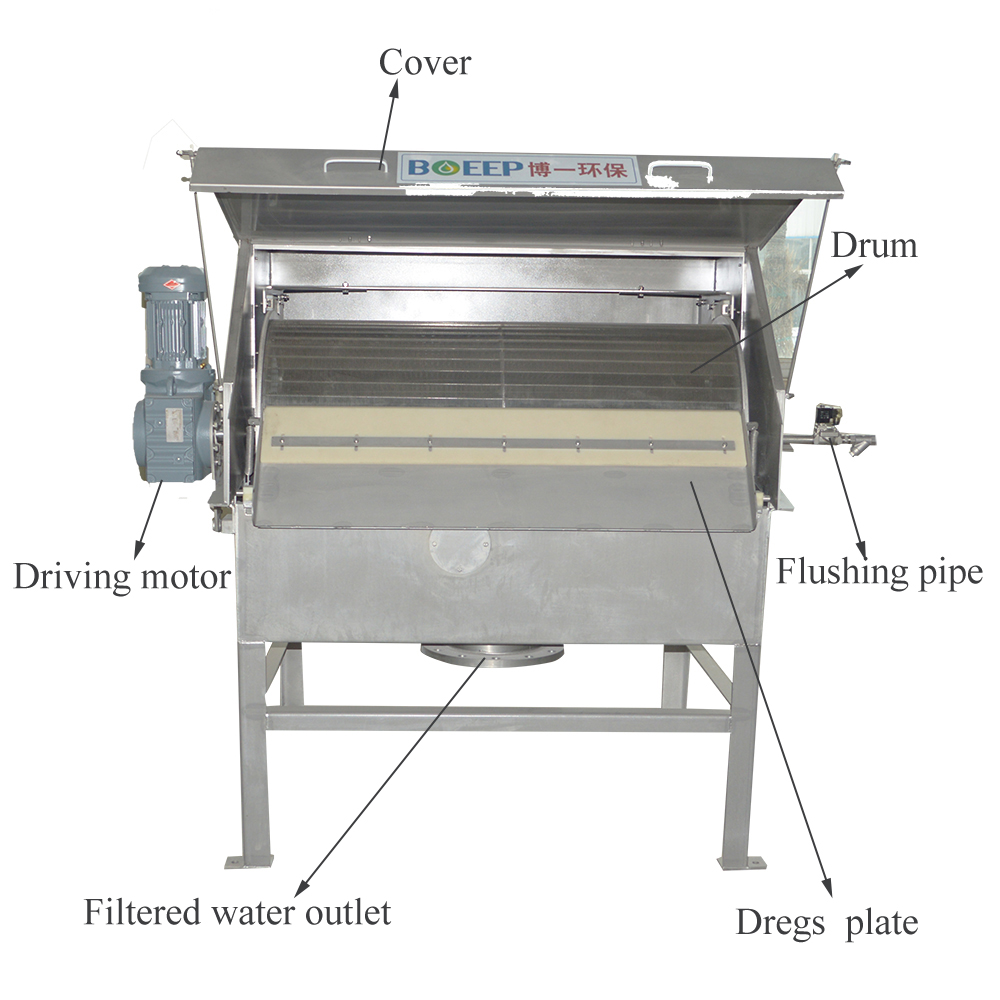
Rotary drum screens introduce a fundamentally different approach to solid-liquid separation. The structural design features a rotating cylindrical drum positioned directly in the flow path. These drums utilize either perforated plates with precise circular holes or wedge wire profiles featuring V-shaped slots. Wedge wire provides a distinct relief angle; if a particle passes the narrowest point at the surface, the gap widens, preventing the particle from getting permanently wedged. This two-dimensional filtration surface prevents long, thin objects from passing through, drastically improving capture rates compared to linear bar screens.
Configurations divide primarily into internal-feed and external-feed designs. Internal-feed screens direct the influent into the center of the open drum. The water passes outward through the screen mesh, leaving debris trapped on the inside surface. Internal augers then move the solids toward a discharge chute, often incorporating a compaction zone that squeezes water out of the screenings to reduce landfill weight. External-feed screens submerge the drum in the channel. Water flows from the outside in, depositing debris on the exterior surface where stationary scraper blades and high-pressure spray nozzles remove it. Transitioning from static screens to inclined rotating drum screens in-channel provides automated, higher-efficiency capture with minimal operator intervention.
Facilities requiring high solids wastewater screening frequently deploy rotary drum technologies. Industrial pretreatment plants, particularly in food processing, slaughterhouses, and pulp mills, rely on these screens to strip heavy organic loads from the effluent before discharging to municipal sewers. Municipal plants utilize them for secondary fine screening and critical MBR protection. The continuous rotation ensures a constantly renewed filtration surface, preventing the rapid blinding that plagues static fine screens.
The high capture efficiency for fine particles, fibrous materials, and greasy solids stems from the integrated washing and compaction systems. As the drum rotates, captured screenings elevate out of the flow. High-pressure sprayers wash soft organics back into the stream for biological processing, while the inert debris moves into the compaction zone. This process yields a drier, cleaner screenings discharge that significantly reduces odor and disposal costs.
The most distinct advantage over traditional bar screens is the zero carryover geometry. Because the flow must pass through the enclosed drum surface, debris cannot bypass the screening element. There are no gaps at the bottom or sides for rags to slip through. If a particle is larger than the aperture size, the drum captures it. This absolute barrier is vital for protecting sensitive downstream equipment from hair pinning and fiber accumulation.
While highly efficient, rotary drum screen wastewater applications require careful upstream management. These units are highly susceptible to damage from large, heavy debris. A rogue cobblestone or a massive piece of timber can dent perforated plates or bend wedge wire profiles, destroying the screen's integrity and allowing bypass. Consequently, drum screens almost always require upstream coarse screening for protection.
Flow rate limitations present another challenge. Drum screens process less volume per square foot of footprint compared to bar screens. The fine apertures create higher natural headloss. Furthermore, the potential for grease blinding remains high if the automated spray wash systems fail or lose pressure. FOG can quickly coat the fine mesh, reducing hydraulic capacity to zero and forcing an emergency channel bypass. Operators must ensure wash water booster pumps maintain at least 60 to 80 psi for effective cleaning.
Comparing the Screenings Capture Ratio (SCR) reveals a stark contrast between the two technologies. Rotary drum screens consistently achieve higher SCRs, often exceeding 85% for targeted particle sizes. Their two-dimensional apertures trap compressible solids, hair, and fibers that easily defeat linear bars. Bar screens typically max out at a lower SCR, focusing on sheer volume removal rather than absolute fine particle capture.
Performance depends heavily on the physical nature of the captured solids. Rigid debris like branches and plastic bottles are easily managed by coarse bar screens. Compressible materials like flushable wipes tend to extrude through bar spacings under hydraulic pressure. Drum screens excel at capturing these compressible solids, lifting them gently out of the flow without forcing them through the mesh.
Each screen type impacts channel hydraulics differently. Bar screens maintain a relatively open channel profile. They allow high-velocity flows to pass with minimal restriction, making them ideal for managing peak wet weather flows. Rotary drum screens introduce significant flow restriction. The fine mesh creates immediate headloss, requiring careful channel design to prevent upstream surcharging.
Evaluating theoretical versus real-world capacity is critical. Manufacturer flow ratings often assume clean water and ideal conditions. In the field, solids loading, partial blinding, and operational wear drastically reduce actual throughput. A drum screen rated for 10 MGD might only handle 6 MGD during a heavy flush of FOG and wipes. Proper engineering requires applying conservative safety factors to these theoretical ratings.
Installation requirements dictate which technology fits a specific facility. Bar screens utilize standard in-channel mounting. They drop into straight, rectangular concrete channels with minimal modifications. This makes them highly suitable for retrofitting older municipal headworks where space is limited and concrete work is prohibitively expensive.
Rotary drum screens demand more complex civil engineering. While inclined drum screens can fit into modified channels, many external-feed and internal-feed configurations require tank-mounted setups or specialized channel geometries. They often demand more horizontal space and specific drop structures to manage the hydraulic profile. Facility retrofits must account for these spatial and structural demands before purchasing equipment.
Routine maintenance demands differ significantly between the two systems. Bar screen maintenance revolves around mechanical wear parts. Operators must perform regular rake replacements, chain tensioning, and lower sprocket inspections. The heavy lifting action places immense strain on drive motors and shear pins, requiring constant vigilance to prevent catastrophic binding.
Drum screen maintenance focuses on cleaning systems and sealing elements. Spray nozzle cleaning is a daily necessity to prevent blinding. Trunnion wheels, which support the rotating drum, require periodic lubrication and replacement. The neoprene or brush seals that prevent bypass around the drum edges must be inspected frequently. Energy consumption also varies; drum screens often run continuously with high-pressure washwater pumps, whereas bar screens may operate intermittently based on level differentials.
Evaluation Dimension | Bar Screen | Rotary Drum Screen |
|---|---|---|
Primary Function | Coarse screening, heavy debris removal | Fine screening, high solids capture |
Capture Efficiency (SCR) | Moderate (allows fine/compressible bypass) | High (zero carryover geometry) |
Hydraulic Capacity | High throughput, handles surges well | Lower throughput per square foot |
Headloss Generation | Low to Moderate | Moderate to High |
Maintenance Focus | Drive chains, rakes, sprockets | Spray nozzles, seals, trunnion wheels |
Vulnerability | Carryover of fine/fibrous materials | Damage from large rocks/heavy debris |
Operational blinding remains a constant threat in any headworks facility. FOG accumulation and rapid biological growth can seal a screen's apertures within hours. When a screen blinds, the water level rises rapidly, triggering ultrasonic sensors that speed up the cleaning cycle. If the cycle cannot clear the mesh, the water overtops the bypass weir, sending raw sewage directly into the plant. Mitigating this requires robust, automated spray wash systems. Proper aperture selection is equally important; choosing a mesh size too fine for the influent profile guarantees chronic blinding.
Advanced sprayer configurations keep drum screens operational under heavy loads. Implementing dual inside and outside spray bars ensures debris is blasted away from both surfaces. Optimizing sprayer feed lines with dedicated booster pumps guarantees consistent cleaning pressure, regardless of plant water demand fluctuations. Using hot water or steam injection can dissolve stubborn grease deposits that cold water simply pushes around.
Preventing carryover in bar screens requires mechanical tuning. Optimizing rake speeds prevents the mechanical forcing of debris through the bars. Utilizing dual-stage screening—placing a coarse bar screen immediately upstream of a fine bar screen—significantly reduces the volume of material that escapes the primary capture zone. This sequential approach protects downstream equipment while maintaining high hydraulic capacity.
Sudden surges in flow and debris loading test the absolute limits of any headworks installation. Peak wet weather flows bring massive volumes of grit, leaves, and scoured sewer debris. This is known as the first flush effect. Clear rainwater enters the sewer system through inflow and infiltration, scouring weeks of settled debris from the pipes and delivering it to the plant all at once. Bar screens handle these surges by accelerating rake cycles, though efficiency drops as the debris mat thickens. Drum screens risk rapid blinding and upstream flooding if the surge contains high concentrations of fine particulate.
Maintaining compliance during extreme weather events necessitates emergency bypass channels. These parallel channels, equipped with static manual bar racks, allow excess flow to bypass the mechanical screens safely, preventing raw sewage from backing up into the collection system or flooding the headworks building. Redundant screening trains ensure that if one unit fails under load, the parallel unit absorbs the flow without disrupting plant operations.
Partnering with a reliable wastewater screen manufacturer dictates the operational lifespan of your headworks. Material quality and fabrication standards must be uncompromising. Insist on 304 or 316 stainless steel construction to resist the highly corrosive headworks environment. Grade 316 contains molybdenum, offering superior resistance to chlorides and hydrogen sulfide gas. Verify that the manufacturer utilizes proper passivation processes after welding. Acid washing the welds restores the protective chromium oxide layer, preventing localized rusting. Robust drive components, including oversized gearboxes and heavy-duty bearings, are essential for continuous operation.
Customization capabilities separate premier manufacturers from generic suppliers. Headworks channels rarely conform to perfect standard dimensions. The manufacturer must engineer screens to fit your specific channel widths, depth profiles, and discharge elevations. They must also tailor the equipment to handle your unique flow profiles and comply with local discharge regulations.
Aftermarket support dictates your facility's resilience. Evaluate vendor reliability regarding replacement parts availability. When a drive chain snaps or a trunnion wheel seizes, you cannot wait weeks for overseas shipping. Establish long-term operations and maintenance partnerships with manufacturers who provide rapid technical support and maintain robust domestic parts inventories.
Measure your channel approach velocity during peak and low flows to ensure it remains between 1.25 and 3.0 feet per second, preventing grit settling or debris extrusion.
Sample your influent for fats, oils, and grease concentrations to determine if your screening equipment requires integrated hot-water spray washes.
Calculate the exact headloss allowance in your existing channel to verify if a fine mesh drum screen will cause unacceptable upstream surcharging.
Design a redundant bypass channel equipped with a manual bar rack to protect the facility during mechanical failures or extreme storm surges.
Consult with a process engineer to map the specific vulnerabilities of your downstream equipment before finalizing any screen aperture size.
A: Generally, no. They serve different primary functions. Rotary drum screens excel at fine particle capture but remain vulnerable to damage from large, heavy debris. They require a coarse bar screen installed upstream to intercept rocks, heavy wood, and massive rag balls. This sequential setup ensures the drum screen operates safely without structural damage to its fine mesh.
A: Bar screens feature coarse aperture sizes ranging from 6mm up to 50mm or more, specifically designed to catch bulky debris and large rags. Rotary drum screens utilize much finer apertures, usually ranging from 0.5mm to 6mm. They use perforated plates or wedge wire to capture fine suspended solids, hair, and small compressible materials.
A: The rotary drum screen performs vastly better for high solids applications. Its continuous rotation, integrated washing systems, and zero carryover geometry allow it to efficiently capture and remove fine, high-concentration solids. The enclosed drum design prevents compressible materials from bypassing the screen, making it ideal for heavy industrial effluent and agricultural processing.
A: Preventing grease blinding requires robust automated cleaning systems. Operators utilize high-pressure spray bars, often enhanced with hot water, to melt and blast away accumulated fats, oils, and grease. Advanced setups include dual inside and outside spray bars, dedicated booster pumps for consistent pressure, and mechanical scraper blades to continuously shear off sticky debris.
A: With high-quality stainless steel construction and rigorous preventative maintenance, mechanical screens typically last 15 to 20 years. However, mechanical wear parts require frequent attention. Rakes, drive chains, spray nozzles, and rubber seals usually need replacement every one to five years, depending heavily on the grit loading and the frequency of operational cycles.
A: Internal feed screens handle higher flow rates within a smaller footprint and contain odors effectively, making them ideal for municipal flows. External feed screens suit heavy industrial flows with massive solids loading. The external scraping mechanisms on these units manage thick sludge and heavy grease more aggressively than internal auger systems.