Sludge management is a critical part of modern wastewater treatment. It is also one of the most challenging and expensive aspects. The byproduct of cleaning water is a semi-solid slurry called sludge. This material is mostly water, often over 97%. Handling and disposing of this wet, heavy substance is inefficient. This is where the Sludge dewatering process comes into play. It is a vital step for any facility that generates sludge.
What is Sludge Dewatering?
Sludge Dewatering is the process of removing water from sludge to reduce its volume. Think of it like wringing out a wet sponge. The goal is to separate the liquid component (filtrate) from the solid component (cake). By doing this, we transform a large volume of liquid slurry into a much smaller volume of manageable, solid material.
This process is a cornerstone of effective wastewater treatment. Without it, treatment plants would be overwhelmed by the sheer volume of sludge produced daily. The overall process usually starts with conditioning the sludge. Polymers are often added to help the small solid particles clump together into larger, more stable flocs. These larger particles are much easier to separate from the water. After conditioning, the sludge is fed into mechanical equipment that applies force—squeezing, spinning, or filtering—to separate the water from the solids. The resulting "cake" is a semi-dry solid, while the separated water is typically returned to the start of the treatment plant for reprocessing.
Benefits of Sludge Dewatering
Implementing a robust dewatering strategy offers significant operational, financial, and environmental benefits. It’s not just about getting rid of waste; it’s about doing it smartly and sustainably.
Waste Volume Reduction
The most immediate benefit is a drastic reduction in waste volume. Since raw sludge is mostly water, removing that water can reduce the total volume by 80-95%. This means a facility that once produced 100 tons of wet sludge might now only have to manage 5 to 20 tons of dewatered cake. This has a massive impact on storage requirements and handling logistics.
Cost Savings on Transportation and Disposal
Fewer tons of waste mean lower costs. Transportation and disposal fees are almost always based on weight or volume. By dewatering sludge, facilities can dramatically cut their disposal bills. Fewer trucks are needed to haul the waste away, saving on fuel, labor, and vehicle maintenance. Landfill tipping fees are also significantly reduced, directly impacting the operational budget.
Environmental Conservation
Dewatering is good for the planet. By compacting waste, we use less landfill space, extending the life of existing disposal sites and reducing the need for new ones. Furthermore, proper dewatering helps contain potential pollutants within a solid cake, minimizing the risk of leachate contaminating soil and groundwater. It is a key practice for environmental stewardship.
Consistent Cake Dryness with Lower Risk of Spilling/Leaking
Dewatered sludge, or cake, is a solid. It can be shoveled, conveyed, and stacked. Wet sludge, on the other hand, is a messy liquid that can easily spill during transport. These spills are not only a cleanup headache but can also pose an environmental and public relations risk, especially when trucks travel through residential areas. A consistent, dry cake is safer and easier for everyone to handle.
Wastewater Recycling
The water removed during the dewatering process, known as filtrate or centrate, is not discarded. It is captured and recycled back to the head of the wastewater treatment plant. This closed-loop system ensures that the water is fully treated before being released into the environment. It also means the plant is more efficient, as it re-treats its own internal waste stream. In some cases, the final dewatered cake can also be repurposed, for example, as a fuel source in energy-from-waste plants or as a component in compost, further contributing to a circular economy.
Types of Sludge Dewatering Equipment
There is no one-size-fits-all solution for dewatering. The best choice of equipment depends on the type of sludge, the desired final dryness, the available space, and the operational budget. Several types of machines dominate the market, each using a different mechanical principle to achieve separation.
Belt Presses
A belt filter press is a workhorse in many large-scale municipal and industrial facilities. It operates continuously, making it suitable for high-volume applications.
Mechanism and Process
The process involves feeding conditioned sludge onto a porous horizontal belt. In the first stage, gravity does the initial work, allowing free water to drain through the belt. The sludge then travels into a wedge zone, where a second belt from above applies gentle pressure. Finally, the sludge "sandwich" is guided through a series of rollers that get progressively smaller. This serpentine path applies increasing mechanical pressure, squeezing more and more water out of the cake.
Advantages and Applications
The main advantage of a belt press is its ability to handle large quantities of sludge continuously. They are relatively straightforward machines. They perform well with fibrous sludges that dewater easily. You will often find them in pulp and paper mills and large municipal wastewater treatment plants.
High Volume Capacity
Their continuous operation makes them ideal for facilities that generate a constant and significant stream of sludge. While they may not produce the absolute driest cake compared to other technologies, their throughput is often unmatched, making them a cost-effective choice for high-volume scenarios. However, they do require a significant amount of wash water to keep the belts clean and can have a relatively large footprint.
Centrifuges
A decanter centrifuge uses high-speed rotation to separate solids from liquids. It's a compact and efficient technology that has become increasingly popular.
Operating Principle
A centrifuge works on the same principle as a salad spinner but with much greater force. Sludge is pumped into a horizontal, cylindrical bowl that is rotating at thousands of RPMs. The intense centrifugal force, thousands of times greater than gravity, pins the heavier solid particles against the bowl wall. Inside the bowl, a screw conveyor (scroll) rotates at a slightly different speed. This scroll scrapes the compacted solids along the wall to one end for discharge. The lighter liquid phase forms a layer closer to the center and flows out from the other end.
Benefits and Limitations
Centrifuges offer several benefits. They have a small footprint compared to their processing capacity. They are fully enclosed, which helps control odors and aerosols. They can also handle a wide range of sludge types and fluctuations in feed consistency. The main limitations are high energy consumption due to the high-speed motor and high maintenance costs associated with the precision-engineered rotating parts. They can also be quite noisy.
Processing Speed and Energy Requirements
The key benefit is speed. Centrifuges dewater sludge very quickly and continuously. The level of dryness can be fine-tuned by adjusting the bowl speed, scroll speed, and the "pond depth" (the level of liquid inside the bowl). While effective, this speed comes at the cost of high energy use, which must be factored into the total cost of ownership.
Filter Presses
When the goal is to achieve the highest possible cake dryness, a filter press is often the best solution. This technology uses high pressure to produce a very dry, stackable cake.
How They Work
A filter press is a batch-operation machine. It consists of a series of heavy-duty plates lined with filter cloths. A powerful hydraulic ram clamps these plates together, forming a series of sealed chambers. Conditioned sludge is then pumped into these chambers at very high pressure. The pressure forces the water through the filter cloths, leaving the solid particles behind. The solids accumulate and compress within the chambers, forming a firm cake. Once the cycle is complete, the hydraulic ram retracts, the plates separate, and the dry cakes drop onto a conveyor or into a bin below.
Key Benefits and Usage Scenarios
The number one benefit of a filter press is the exceptional cake dryness it produces, often achieving 35-50% solids or more. This significantly reduces disposal costs. They are extremely reliable and have relatively low energy consumption since the main power draw is from the feed pump and the hydraulics. They are ideal for applications where disposal costs are very high or where the cake is being sent for incineration, which requires a low moisture content.
Produces Stackable Cakes
The final product from a filter press is a true solid. The cakes are so dry and compact that they can be easily stacked and handled. This makes transportation and storage simple and clean. The main trade-off is that it's a batch process, which means it has a lower hourly throughput compared to a continuous machine of a similar size. However, for many facilities, the superior cake quality is well worth the trade-off.
Screw Presses
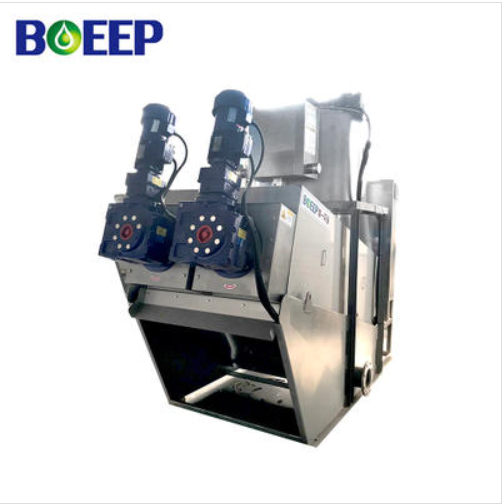
Screw presses are a newer generation of dewatering technology known for their low energy consumption, quiet operation, and automated functionality. They are particularly effective for certain types of sludge.
Mechanism and Process
A screw press consists of a slowly rotating screw (auger) inside a cylindrical screen. The screen is composed of a stack of fixed and moving rings or a perforated drum. As the screw turns, it conveys the sludge from the inlet to the outlet. The pitch of the screw and the diameter of the shaft often change along the length, gradually compressing the sludge. The space between the rings of the screen allows water to escape while retaining the solid particles. The slow movement of the moving rings against the fixed rings provides a self-cleaning action, preventing clogging.
Advantages and Applications
The main advantages are its very low power consumption, minimal noise, and low water usage for cleaning. The slow-moving parts result in less wear and tear and lower maintenance costs. Screw presses are highly automated and can often run for long periods unattended. They excel at dewatering oily sludges, such as those from food processing plants, and are also widely used in smaller municipal facilities. For example, some advanced
Sludge dewatering equipment includes self-cleaning features, making it ideal for municipal plants where continuous, low-maintenance operation is key.
Sludge Dewatering Methods
Choosing the right equipment is a critical decision. It involves comparing different Sludge dewatering methods and understanding which one best fits your specific operational needs, sludge characteristics, and long-term goals.
Comparison of Dewatering Methods
Each dewatering technology has its own profile of strengths and weaknesses. A direct comparison can help clarify which system is the best match for a given application.
| Feature | Belt Press | Centrifuge | Filter Press | Screw Press |
| Cake Dryness (% Solids) | 15-25% | 20-35% | 35-50%+ | 20-30% |
| Process Type | Continuous | Continuous | Batch | Continuous |
| Energy Use | Moderate | High | Low-Moderate | Very Low |
| Footprint | Large | Small | Large | Small-Moderate |
| Labor Requirement | Low-Moderate | Low | Moderate (High if manual) | Very Low |
| Polymer Use | High | High | Moderate-High | Moderate-High |
| Best For | High volumes, fibrous sludge | Oily sludge, variable feeds | Maximum dryness, stable sludge | Oily/greasy sludge, low energy needs |
| Noise Level | Moderate | High | Low | Very Low |
| Wash Water Use | High | Low | Low (for cloth washing) | Very Low |
Efficiency and Effectiveness
Filter Presses are the most effective at water removal, producing the highest cake solids.
Centrifuges are highly efficient in terms of processing speed and footprint.
Belt Presses are efficient for processing very large, continuous flows.
Screw Presses are the most efficient in terms of energy consumption and automation.
Suitability for Different Sludge Types
The nature of the sludge is a primary factor. Oily and greasy sludges, which can blind the cloths of a filter press or belts of a belt press, are handled very well by centrifuges and screw presses. Fibrous sludges, like those from the paper industry, are well-suited for belt presses. Biological sludges from municipal plants can be dewatered by any of the technologies, but the final choice often comes down to the desired dryness and operating costs.
Selecting the Right Dewatering System
Making the right choice requires a holistic assessment of your facility's needs. It is not just about the initial purchase price but the total cost of ownership over the machine's life.
Factors to Consider
Sludge Characteristics: What is the source of your sludge? Is it primary, secondary, digested, industrial? What is its typical solids content and particle size?
Performance Goals: What is your target cake dryness? Is the goal simply volume reduction for landfilling, or is the cake being used for another purpose like incineration?
Throughput Requirements: How much sludge do you generate per day? Is the flow constant or intermittent?
Capital and Operating Costs (CapEx vs. OpEx): Consider the initial purchase price, installation, energy consumption, polymer usage, maintenance costs, and labor requirements.
Footprint and Site Constraints: How much space is available? Are there height or weight limitations?
Labor and Automation: How much operator attention can you dedicate to the system? Is a fully automated, "lights-out" operation a priority?
Matching Equipment to Specific Needs
By weighing these factors, a clear choice often emerges. A facility with extremely high disposal costs will likely prioritize the high cake dryness of a filter press. A plant with limited space and variable sludge might lean towards a centrifuge. A small facility looking for a low-maintenance, energy-efficient solution would find a screw press very attractive. The choice also depends on site logistics. For remote sites or temporary needs, a complete, containerized
Sludge dewatering system can be the perfect solution, offering plug-and-play functionality without permanent construction.
Maintenance and Troubleshooting
Even the best Sludge dewatering unit requires proper care to perform optimally. A proactive maintenance program is essential for maximizing uptime, ensuring consistent performance, and extending the life of the equipment.
Best Practices for Equipment Maintenance
Good maintenance is not an expense; it is an investment. Following these best practices will prevent costly breakdowns and ensure your dewatering system runs smoothly.
Routine Checks and Cleaning: Operators should perform daily visual inspections. They need to look for leaks, check gauges, and listen for any unusual noises or vibrations. Regular cleaning is crucial. Sludge buildup can cause wear, reduce efficiency, and lead to premature component failure.
Lubrication and System Monitoring: All dewatering equipment has moving parts that require regular lubrication. Follow the manufacturer's recommended schedule and use the specified lubricants. Modern systems often include sensors to monitor critical parameters like temperature, pressure, and vibration. Keep an eye on these indicators to catch problems early.
Train Staff on Proper Equipment Operation: The single most important maintenance tool is a well-trained operator. Staff should be thoroughly trained on how the equipment works, the normal operating parameters, and the proper startup and shutdown procedures. They are the first line of defense in identifying potential issues.
Keep a Record of Maintenance and Repairs: Maintain a detailed logbook for each piece of equipment. Record all maintenance activities, parts replaced, and any issues encountered. This history is invaluable for troubleshooting recurring problems and planning future maintenance.
Common Troubleshooting Tips
Despite regular maintenance, problems can still arise. Knowing how to address common issues can save significant downtime.
Addressing Belt Press Issues
Resolving Centrifuge Problems
Filter Press Maintenance
Summary & Recommendations
Sludge dewatering is an indispensable process in waste management. It is crucial for controlling costs, protecting the environment, and ensuring efficient plant operations. From belt presses handling massive volumes to filter presses producing incredibly dry cake, a variety of Sludge dewatering equipment is available to meet diverse needs. Technologies like centrifuges offer speed and a compact footprint, while screw presses provide a low-energy, highly automated solution.